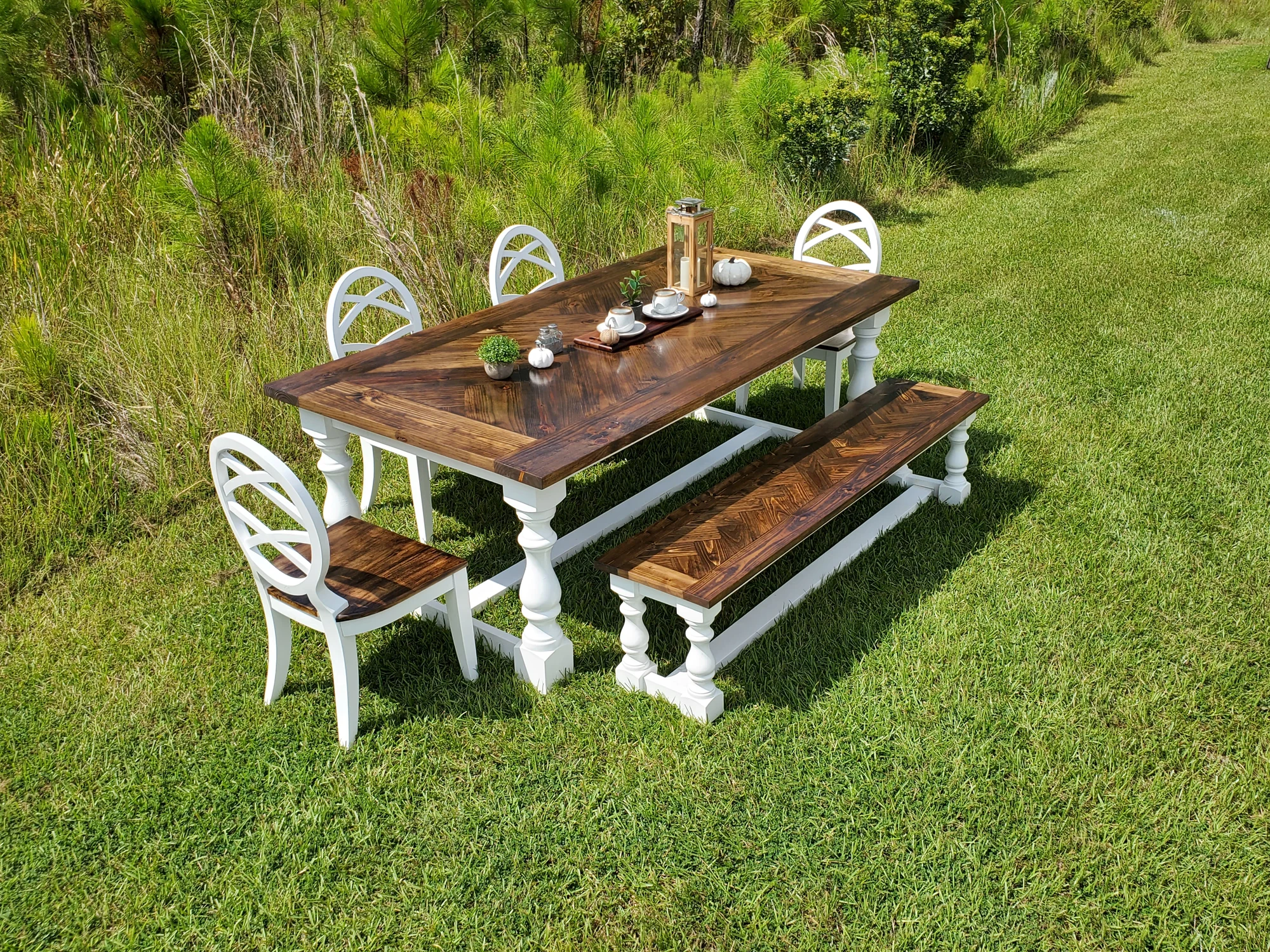
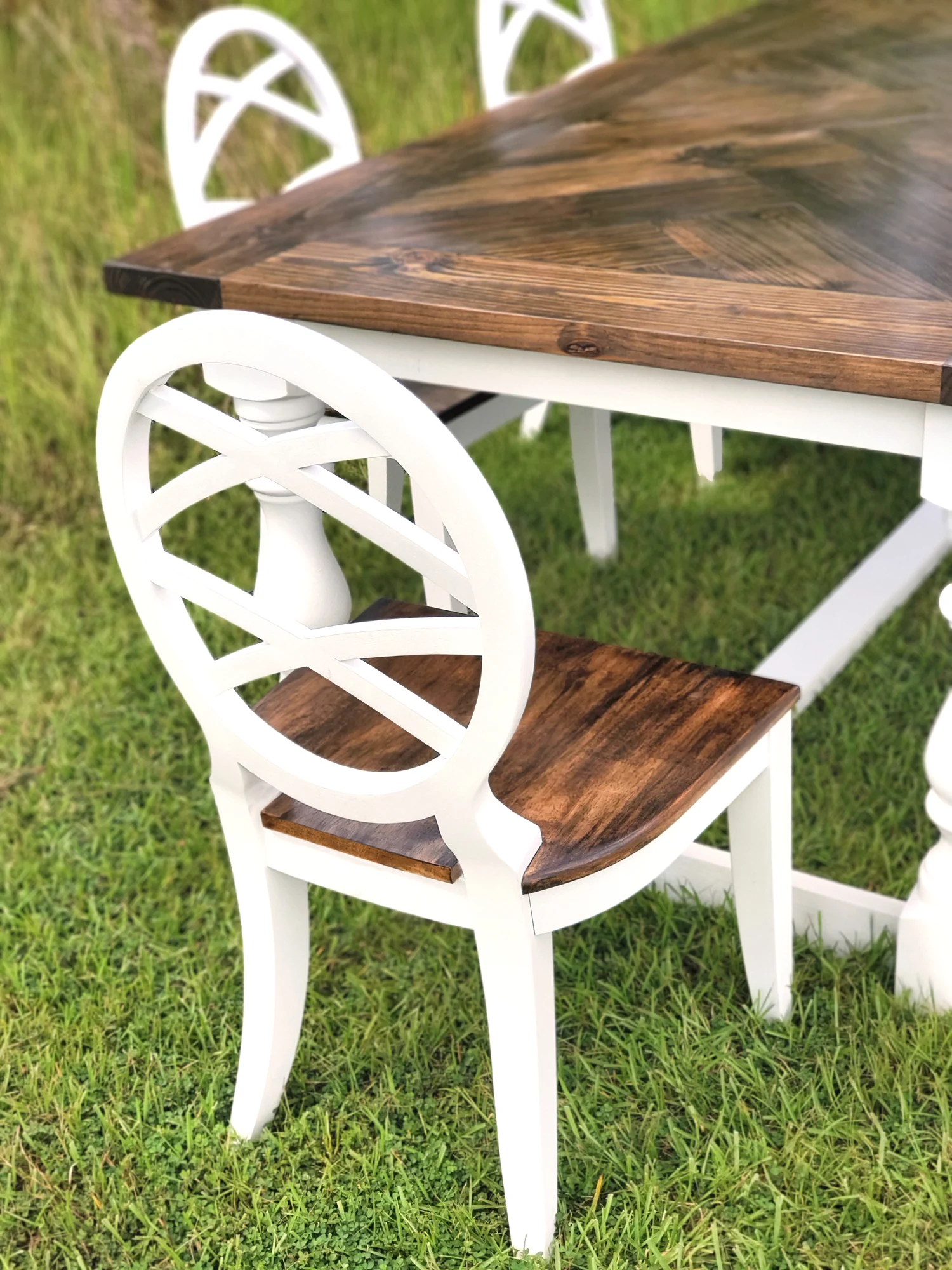
A finished brown herringbone dining table is the first thing I want you to see: the patterned top, white turned legs, a matching bench, and white chairs with dark wood seats. Then look under the table. In the workshop photograph, I am wearing a mask and holding a drill beneath the unfinished base. That less polished view belongs to the same story as the finished set.
Here is the useful idea right away. Let the herringbone be the one strong graphic feature. Repeat the dark wood in the bench and chair seats, then give the whole arrangement breathing room with a white base. Before you fall in love with the top alone, check the view from beneath it and the space for the people who will sit there.
The top leads the room
From a distance, the brown wood reads as one generous surface. Step closer and the herringbone starts to move. The changes in grain and direction bring energy to a familiar farmhouse shape. I like that the pattern is made by the wood itself; it does not need a painted motif or much styling to feel special.
The border gives the center a clear edge. On a large surface, that little bit of structure helps the eye understand where the pattern begins and ends. The deep color gives the table presence, while the different tones within the boards keep it from becoming one flat dark rectangle.
I styled the finished table lightly. A few cups, greenery, and a lantern show its scale, but there is still room to see the wood. At home, I would start the same way. Let the table do its work visually, then add the objects that people actually use and love.
When you are considering a patterned top for your own space, look at it from two places: directly above and from across the room. Close up, each angle can be exciting. From a doorway, the question is whether the whole top feels warm and balanced. Most of the time we experience furniture while moving around it, not standing over it like a plan drawing.
A bench with a purpose
The bench is more than a matching accent. It repeats the table's dark wood and white turned supports on a smaller scale, but it also changes the way people can gather. There is room to make space for one more person, and that long side of the table stays visually open when the bench is tucked in.
I always look at where the bench meets the table legs. If the supports make the seat awkward to reach, the prettiest profile will not fix that in everyday use. Pull it out, imagine someone standing up, and consider how much walking room remains. Those are small practical checks that make the finished piece feel welcoming.
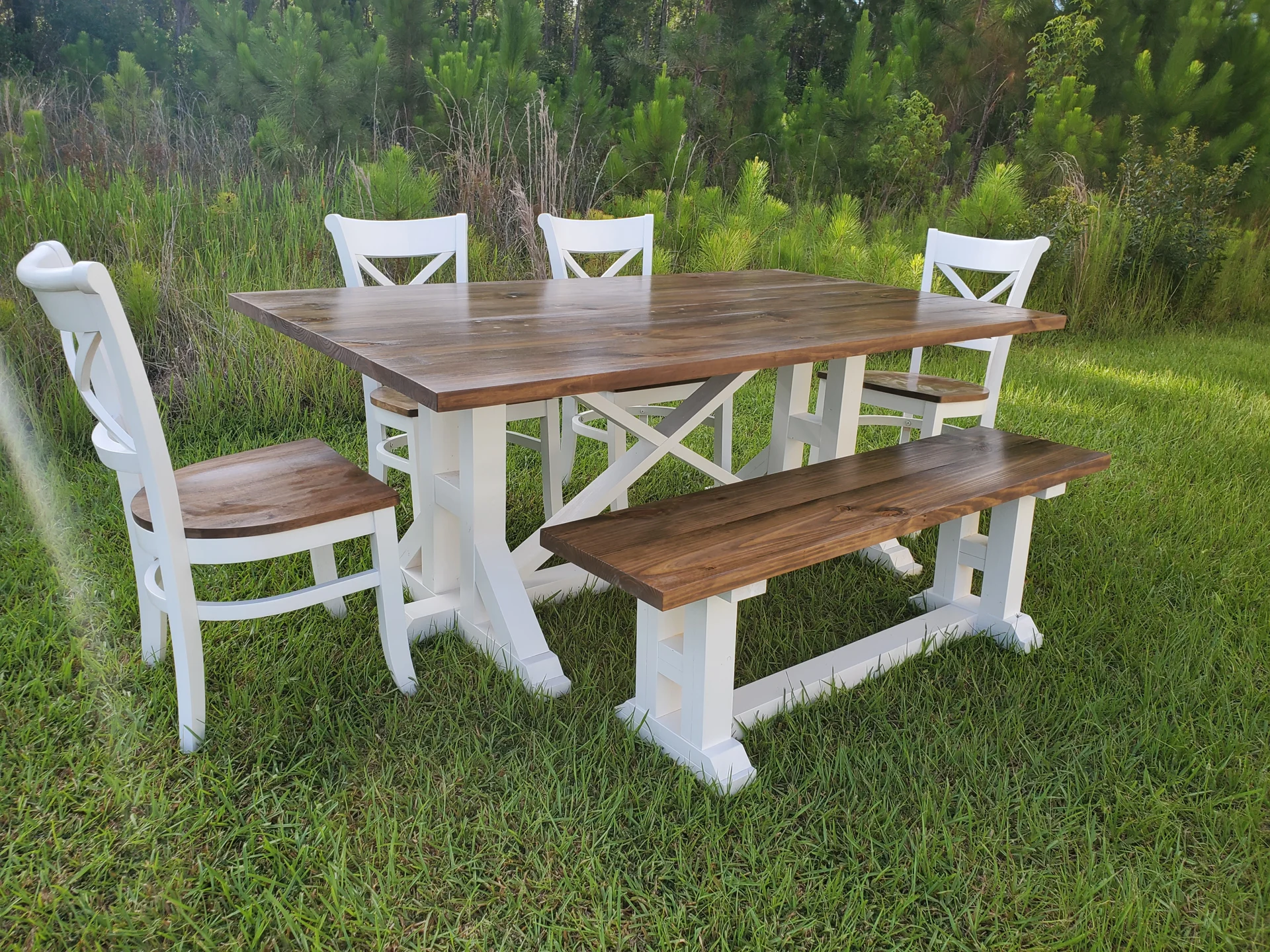
The chairs bring a different shape. Their white curved backs do not copy the turned legs, and I like that. The darker seats echo the tabletop, so the whole group feels related without being perfectly uniform. A room can feel collected and intentional when the finishes speak to one another even as the silhouettes change.
Why the base is white
With a dark patterned top, I wanted the lower half to feel light. White paint outlines the turned legs and lets you see the apron and supports as separate parts. Against the long brown surface, the base has enough presence to hold its own without competing for attention.
Contrast can do a useful job in furniture. It shows the shape. The rich top carries the strongest visual weight; the painted base makes the volume below it easier to read. The bench repeats that relationship, and the chairs carry it around the table.
A finish sample can be misleading when you see it by itself. A dark brown on a small offcut may seem heavier than it does across a herringbone pattern with natural highlights. White paint on a swatch may seem plain, but on turned legs beside the wood it defines every curve. If you are choosing finishes, put samples next to the room's floor and chairs, then picture them at the full scale of the furniture.
The view from underneath
The workshop photograph shows me beneath the unfinished table with a mask and drill. I love it because the camera is looking at the side of the project that disappears in the final photograph. There is no styled place setting or finished tabletop to distract from the connections and the space around the legs.
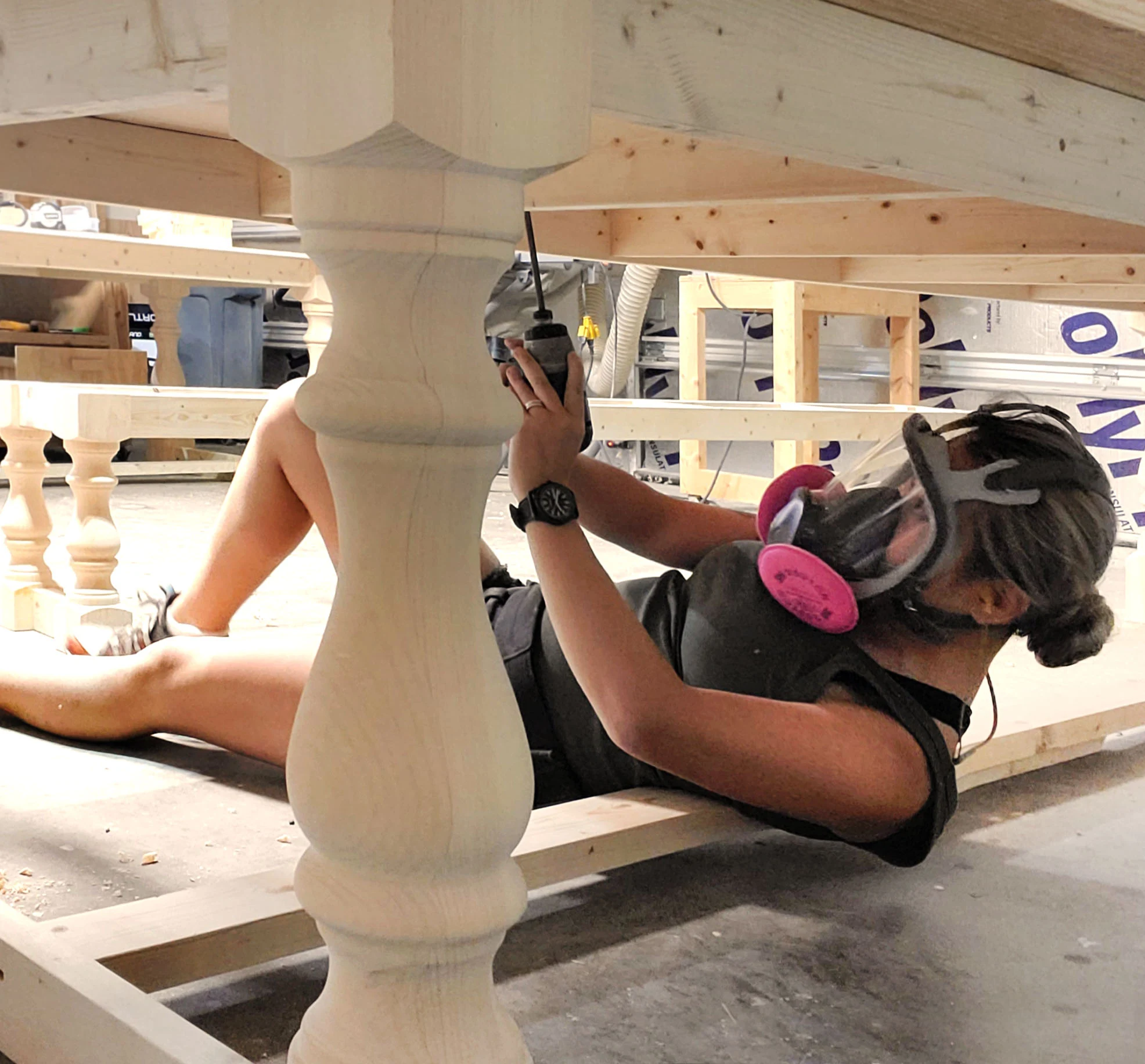
One photograph is not a step-by-step construction guide. It does not tell you which fastener or measurement to use in your own build. It does show why I pause to look underneath before I decide that a design feels right. The base needs to support the tabletop, leave space for knees, and let the seating land where it belongs.
I like to look at a table from standing height and then from chair height. Can a person pull up comfortably? Does the apron interfere? Are the turned legs visible in a way that feels balanced, or do they crowd the ends? These ordinary questions are easy to miss when all your attention is on a beautiful top.
The work behind a piece rarely looks as glamorous as its finished image. A drill in hand, a mask on, and a look up at the underside: that is part of the real project. It is why I share workshop moments alongside the reveal. The useful choices happen before the final photo.
Three views of one project
The wide image gives you the full table, bench, and chairs together. The closer view lets you see the relationship between the brown wood and a white chair. The workshop view takes you beneath the table. These three images are from this herringbone project; they are enough to tell its story without bringing in furniture from another commission.
When I step back from the full set, the top is still the headline. The bench extends its pattern and color. The light legs give the arrangement a rhythm, and the chairs make it feel like somewhere people could actually sit. Each choice has a visual part and a practical part.
If you are borrowing an idea from this table, begin with the room. Mark the footprint, leave a path around the chairs, and decide which side benefits from a bench. Then choose the element that should lead. Here it is the herringbone surface. Once that decision is clear, the other finishes can support it rather than compete with it.
What stays with me is the distance between the two kinds of photographs. In one, the table looks ready for a home. In another, I am underneath it, still working. Furniture has to belong in both worlds: it needs to be thoughtfully made, and it needs to give people somewhere to gather after the tools are put away.
Note
Save three ideas from this set: one wood pattern that leads, a lighter base that frames it, and seating planned around real people. You can make the finish and the room your own. The balance is the part worth remembering.
Joy